
Artificial Intelligence (AI) Course Training in Thane
India's leading Artificial Intelligence course with an industry-relevant curriculum! Learn from expert faculty with hands-on experience, and benefit from a comprehensive job-readiness program to build practical skills and prepare for a successful AI career.

Students Enrolled
7,250

Reviews
4.8

Duration
6 Months
Learning Milestones
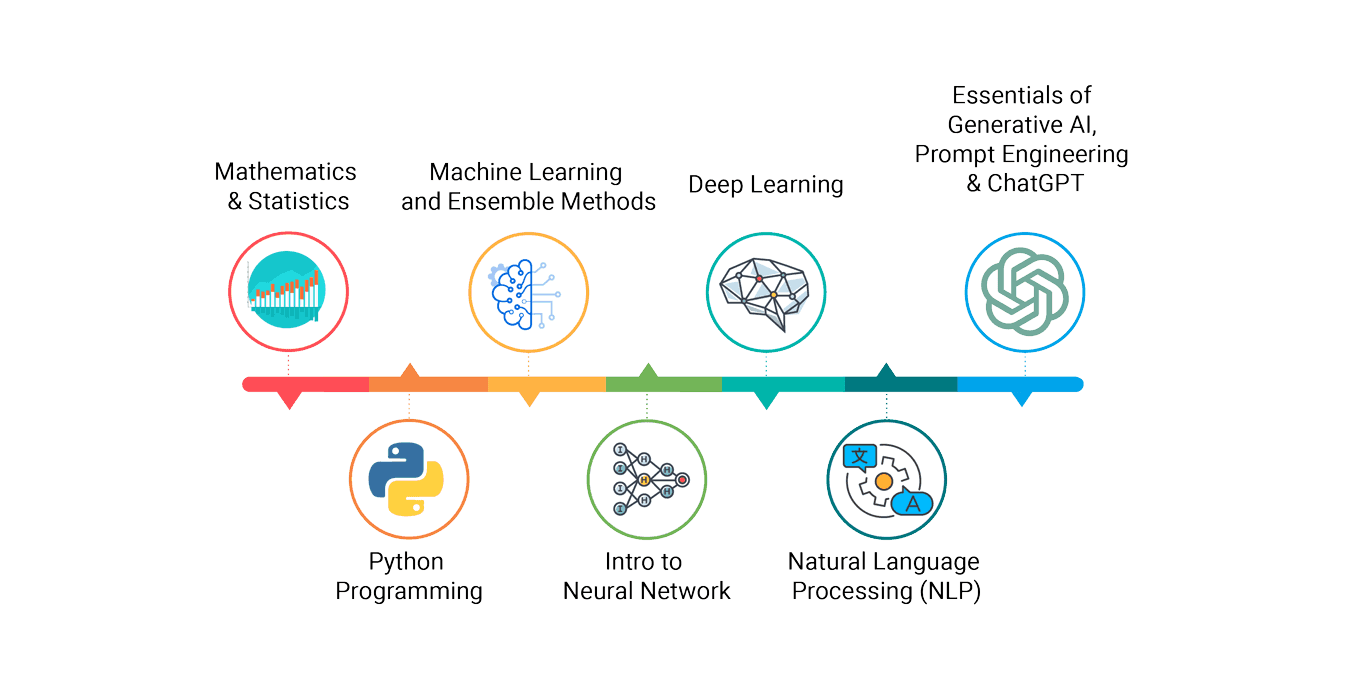
Program Highlights

Top-Notch Faculty

Exhaustive Course Curriculum

Job Readiness

Real-life Projects
Skills Covered

Deep Learning
Natural Language Processing

ChatGPT

Computer Vision

Machine Learning Algorithms

Model Training and Optimization

Model Evaluation and Validation

Ensemble Methods

Generative AI

Prompt Engineering

Reinforcement Learning

Speech Recognition

Statistics
Tools and Technologies

ChatGPT

DALL-E 2

Gbard

Pytorch

Python

TensorFlow

Keras

Matplotlib

NLTK

Scikit-learn

OpenCV

NumPy
Course Overview:
This Artificial Intelligence (AI) course is a 130-hour training program meticulously designed to help working professionals and freshers know the framework, intertwined concepts, utility tools, and other best practices in Artificial Intelligence, inside out! The elaborate curriculum and other highlights outlined in this brochure explain in detail why you should immediately embark on your learning journey with us. The modules cover a vast array of Artificial Intelligence tools like ChatGPT, DALL.E 2, Gbard, Pytorch, Python, Tensor Flow, Keras, OpenCV, NumPy, etc. With instructor-led theory classes integrated with labs and capstone projects, you’re sure to master Artificial Intelligence (AI)!
Projects
Project 1: Sentiment Analysis
- Beginner Level
- AI project to develop a model to classify text data, such as social media posts or customer reviews, into sentiments like positive, negative, or neutral. The project involves collecting and pre-processing text data, using tools like NLTK or spaCy for tasks like tokenization and lemmatization. Feature extraction is achieved through techniques such as TF-IDF or word embeddings (e.g., Word2Vec). Machine learning or deep learning models, implemented using TensorFlow, PyTorch, or Scikit-learn, are trained, and tested on this data. The project offers practical experience in natural language processing and sentiment classification.
Project 2: Synthetic Image generation
- Beginner Level
- A beginner level GAN (Generative Adversarial Network) project, for the fashion industry, involves creating a model that can generate new, realistic clothing designs. In this project, the GAN consists of two parts a Generator, which produces images of clothing items, and a Discriminator, which evaluates whether these images are real or generated. The training process involves feeding the network with a dataset of various clothing images, allowing the Generator to learn and create novel designs while the Discriminator improves its ability to distinguish between real and synthetic images.
Project 3: Machine Translation
- Intermediate Level
- One of the earliest goals for computers was the automatic translation of text from one language to another. Automatic or machine translation is perhaps one of the most challenging artificial intelligence tasks given the fluidity of human language. Objective is to translate phrases in one language to another language. Any dataset from the web can be used for this project. We get to work using transformer self-attention models for example T5 model (text to text transformer model) from Hugging face library. We also learn how to design encoder and decoder LSTM models for translation.
Project 4: Comparative Analysis of CNN architectures/models on Image classification problem and object detection problems
- Intermediate Level
- Explore and identify at least 10 CNN architectures/ models which are used in image classification and object detection problems. Work on understanding these architectures by reading literature, papers etc and do comparative analysis of these models on image classification and object detection datasets. We learn how to design and train a deep learning CNN model for image classification and object detection problems. We also learn how different CNN deep learning models are and find out which is the best model.
Project 5: Captioning of Images and photographs
- Advanced
- The objective is to caption the image in your dataset (Download it from web) and come up with a suitable title for the image and then try it on a video and see if it can work on video as well. You are free to use a mix of CNN and RNN, LSTM models for this project. We learn how to prepare photo and text data for training a deep learning model, how to design and train a deep learning caption generation model and how to evaluate a train caption generation model and use it to caption entirely new images and photographs.
Project 6: Video Recommendation system
- Advanced
- Data extraction from YouTube using API's. Work on clear exploratory data analysis. Build recommendation engine using that video contents. Need to deploy the entire setup. Create an application for your model. Learning outcome, we will know how to extract data using YouTube using API's and how to design and train a deep learning video recommendation model and how to evaluate a deep learning video recommendation model and deployment.
Case Studies
Case Study 1: CNN Project On Ecommerce Product Image Classification
- A CNN (Convolutional Neural Network) project focused on e-commerce product image classification involves designing a neural network to automatically categorize product images into predefined classes. This system uses CNN's ability to extract features and recognize patterns in images, making it highly effective for visual data analysis. The classification process helps in organizing and managing large e-commerce inventories, improving search and recommendation systems.
Case Study 2: Synthetic Image Generation
- Another friendly GAN project involves generating human faces using the CelebA dataset, a collection of celebrity face images. The goal is for the Generator to create new, realistic-looking faces, and for the Discriminator to differentiate between these generated faces and real images from the dataset.
Case Study 3: Coversational ChatBot
- A chatbot project using neural networks involves developing an intelligent conversational agent capable of understanding and responding to user queries in natural language. The neural network, typically a form of deep learning model like LSTM (Long Short-Term Memory) or Transformer, is trained on large datasets of conversational text to learn language patterns and context. This chatbot can be integrated into various platforms, such as customer service portals, to provide automated, 24/7 assistance.
Case Study 4: Reinforcement Learning
- Difficulty Level
- Build a Reinforcement learning model to solve a straightforward problem like navigating a maze. In such a project, the Q-learning algorithm, a form of model-free reinforcement learning, is used to teach an agent how to make optimal decisions to maximize a cumulative reward in a defined environment. The agent learns by exploring the environment, receiving feedback in the form of rewards or penalties, and updating a Q-table that maps state-action pairs to rewards.
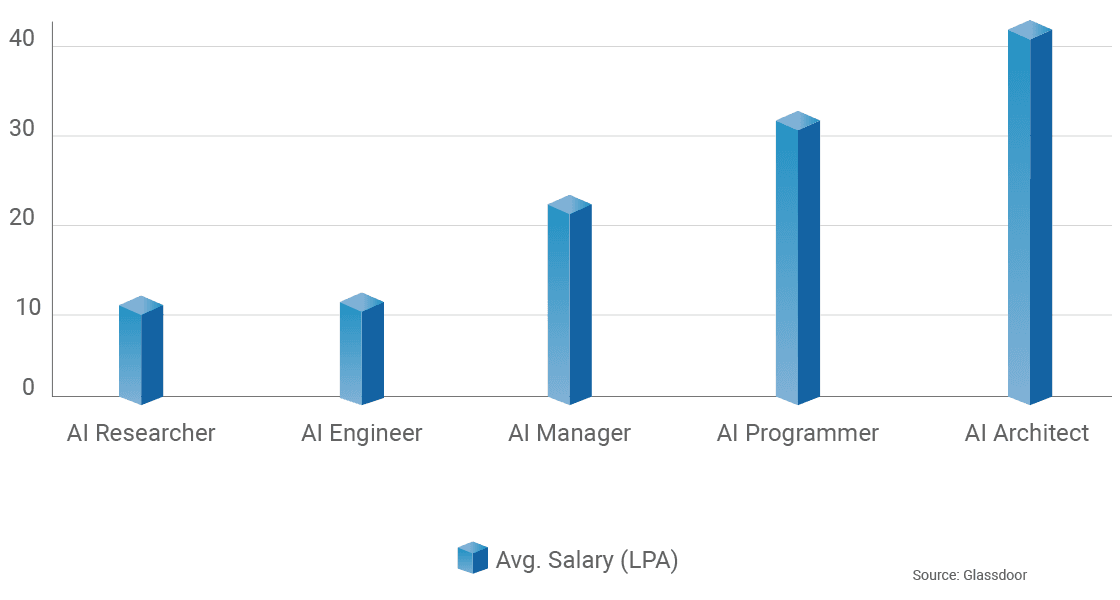
Career Progression and Salary Trends
Learning Path
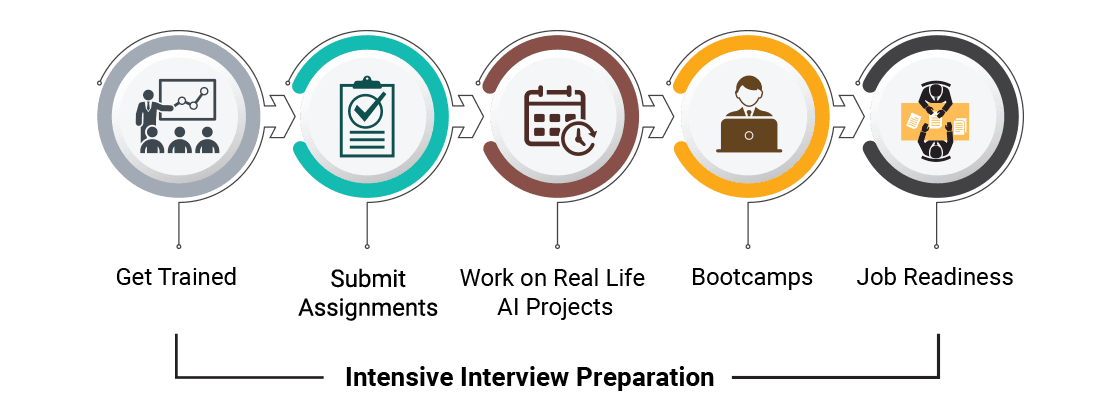
Why ExcelR

Industry-Based Course Curriculum

Value Added Courses: Python,ChatGPT,Prompt Engineering,Generative AI and MLOps

Hands-on with 20+ Assignments

Job Readiness Program with our 2000+ partner companies

Support through WhatsApp, Calls, & Emails

Lifetime eLearning Access
Course Curriculum
Module 1 - Introduction to Machine Learning and AI
- Basic Concept
- ML and AI introduction
- Applications of ML and AI
Module 2 -Programming
- Python
- Basic Programming
- NLP Libraries - Spacy & Gensim
- OpenCV & Tensorflow, Keras
Module 3 - Math foundation
- Basic Statistics
- Sampling & Sampling Statistics
- Inferential Stats : Hypothesis Testing
- Calculus
- Derivatives
- Optimization
- Linear Algebra
- Function
- Scalar-Vector-Matrix
- Vector Operation
- Probability
- Space
- Probability
- Distribution
Module 4 - Machine Learning and Ensemble Methods
- Unsupervised
- Unsupervised K-Means & Hierarichal Clustering
- Linear Regression
- Logistic Regression
- Evaluation Metrics
- Train,Test & Validation Distribution
- Supervised
- Gradient Descent
- Decision Tree & KNN
- Random Forest | Bagging & Boosting
Module 5 - Intro to Neural Network & Deep Learning
- Introduction
- Intro
- Deep Learning Importance [Strength & Limiltation]
- SP | MLP
- Feed Forward & Backward Propagation
- Neural Network Overview
- Neural Network Representation
- Activation Function
- Loss Function
- Importance of Non-linear Activation Function
- Gradient Descent for Neural Network
Module 6 - Parameter & Hyperparameter
- Practical Aspect
- Train, Test & Validation Set
- Vanishing & Exploding Gradient
- Dropout
- Regularization
- Optimization
- Bias Correction
- RMS Prop
- Adam,Ada,AdaBoost
- Learning Rate
- Tuning
- Softmax
Module 7 - Computer Vision
- Image preprocessing
- Introduction to Computer Vision ,Image, image transformation, filters, noise removal, edge detetction, non-max suppression , hysterisis
- Advanced CNN concepts -1
- "Object detection concepts, Bounding box, object detection models, landmark detection, RCNN, fast RCNN, faster RCNN, mask RCNN, YOLO pre-trained models, transfer learning , segmentation concepts"
- Advanced CNN concepts -2
- Advanced CNN models applications, face detection and recognition, different techniques in face recognition, style transfer
Module 8 -Speech Analytics
- Speech Processing
- "Introduction, Automated Speech Recognition (ASR) "
- Speech Synthesis
- text to speech conversion, voice assistant devices, building alexa slkills
Module 9 - Generative
- Autoencoders & Decoders
- Basics of autoencoders, different types of autoencoders, applications with examples , variational autoencoders, intro to Gen AI
- Generative Adverserial Networks (GAN's)
- GAN basics and foundations, upsampling , GAN models, evaluate GAN Models, inception score, frechet inception distance, GAN loss functions
- GAN's different types
- Conditional GAN, Info GAN, Auxillary GAN etc, applications
- GAN use cases
- Image translation applications, cycle GAN concepts and implemenations
Module 10 -Reinforcement Learning
- Reinforcement Learning
- Intro to RL, Q learning, Exploration , exploitation
- Reinforcement learning applications
- Work with deep RL libraries, openai gym library, policy gradient concepts, Actor-critic methods, Proximal policy Optimization (PPO) and related concepts
Module 11 -RNN and LSTM
- Forecasting deep learning
- ARIMA, Deep learning models for forecasting (RNN, LSTM , Transformer applications)
Module 12 - NLP
- Basic NLP concepts & models
- "Introduction to Text Mining,VSM, word embeddings applications, RNN , GRU, LSTM models, Intro to Transformers, Attention (Elmo, BERT , T5)"
- "Text Mining & NLP applications, Web Scraping"
- "Word clouds and Doucument Similarity using cosine similarity, Named Entity Recognition, machine translation using hugging face libraries, Emotion Mining using different libraries, web scraping"
- Naive Bayes
- "Text classification using Naïve Bayes, frequqentists vs bayesian , apriori, posteriori distributions Bayesian estimators: posterior mean, posterior median"
- "Advanced NLP models , Generative AI using LLM's"
- "Intro to Transformers & Attention (Single Head,Multi Head) , pretrained models (GPT, BERT ,BART, T5) models with applications , examples using python Intro to Different types of Transformer encoder models- Basic BERT, RoBERTa, DistilBERT etc. Intro to Different types of Transformer decoder models-GPT, GPT2, other variants of GPT etc, GPT progress, calling OPENAI api's , LLM playgrounds Intro to Different types of Transformer sequence to sequence models-BART, T5"
Value Add Courses
Basics of Python
- Introduction
- Python Introduction - Programing Cycle of Python
- Python IDE and Jupyter notebook
- Variables
- Variables
- Data type
- Code Practice Platform
- create , insert , update and delete operation , Handling erros
- Operators
- Operator -Arthmatic ,comparison , Assignment ,Logical , Bitwise opeartor
- Decision making - Loops
- Loops
- While loop, for loop and nested loop
- Number type conversion - int(), long(). Float ()
- Mathametical functions , Random function , Trigonometric function
- Sting
- Strings- Escape char, String special Operator , String formatting Operator
- Build in string methods - center(), count()decode(), encode()
- List
- Python List - Accessing values in list, Delete list elements , Indexing slicing & Matrices
- Built in Function - cmp(), len(), min(), max(), list comprehension
- Tuples
- Tuples - Accessing values in Tuples, Delete Tuples elements , Indexing slicing & Matrices
- Built in tuples functions - cmp(), len ()
- Dictionary
- Dictionary - Accessing values from dictionary, Deleting and updating elements in Dict.
- Properties of Dist. , Built in Dist functions & Methods, Dict comprehension
- Date & time -Time Tuple , calendor module and time module
- Function
- Function - Define function , Calling function
- pass by refernece as value , Function arguments , Anonymous functions , return statements
- Scope of variables - local & global , Decorators and recursion
- Map reduce and filter
- Operators
- Operator -Arthmatic ,comparison , Assignment ,Logical , Bitwise opeartor
- Decision making - Loops
- Modules
- Import statemnts , Locating modules - current directory , Pythonpath
- Dir() function , global and location functions and reload () functions , Sys module and subprocess module
- Packages in Python
- Files
- Files in Python- Reading keyboard input , input function
- Opening and closing files . Syntax and list of modes
- Files object attribute- open , close . Reading and writing files , file Position.
- Renaming and deleting files
- Pickle and Json
- Directories
- mkdir methid, chdir () method , getcwd method , rm dir
- Exception Handling
- Exception handling - List of exceptions - Try and exception
- Try- finally clause and user defined exceptions
- OOP
- OOP concepts , class , objects , Inheritance
- Overriding methods like _init_, Overloading operators , Data hiding
- Regular Expressions
- match function , search function , matching vs searching
- Regular exp modifiers and patterns
- SQLite and My SQL
- Data base connectivity
- Methods- MySQL , oracle , how to install MYSQL , DB connection
- create , insert , update and delete operation , Handling erros
- Framework
- Introduction to Django framwork , overview , environment
- Apps life cycle , creating views
- Application, Rest API
ChatGPT
- Introduction to ChatGPT and AI
- What is ChatGPT?
- The history of ChatGPT
- Applications of ChatGPT
- ChatGPT vs other chatbot platforms
- Industries using ChatGPT
- The benefits and limitations of ChatGPT
- Future developments in ChatGPT technology
- Ethical considerations related to ChatGPT and AI
- Types of AI and Chatgpt architecture
- Narrow AI
- Strong AI
- Superintelligence
- Chatgpt architecture
- ChatGPT Functionalities and Applications
- How does ChatGPT work?
- ChatGPT Functionalities
- Drafting emails and professional communication
- Automating content creation
- Resume and Cover letter creation
- Research and information gathering
- Brainstorming ideas and creative problem solving
- Best Practices for Using ChatGPT
- ChatGPT Prompt Engineering
- What is Prompt Engineering?
- Types of Prompts
- Crafting Effective Prompts
- Using ChatGPT to generate prompt
Prompt Engineering
- Foundations of Generative AI
- Understanding AI: Descriptive vs Generative AI
- The nature of AI, comparison of descriptive and generative AI
- Introduction to Natural Language Processing
- Core concepts in NLP, basics of language understanding
- Understanding Large Language Models (LLMs)
- Overview of LLMs, their scope, capabilities, and use cases
- Introduction to GPT & Chat GPT
- What is GPT, its evolution, and generational changes
- Understanding AI: Descriptive vs Generative AI
- Introduction to Prompt Engineering
- The Fundamentals of Prompt Engineering
- What is prompt engineering, its importance, types of prompts
- Content Generation with Prompts
- Strategies for generating text, video scripts, and music using prompts
- Tokens and Parameters in AI
- The role and understanding of tokens, introduction to prompt parameters
- The Fundamentals of Prompt Engineering
- Advanced Prompt Techniques
- Zero-Shot to Few-Shot Learning
- Deep dive into zero-shot, one-shot, and few-shot learning
- Fine-Tuning AI Model Parameters
- Introduction to model parameter adjustments
- Hallucinations and Bias in AI
- Strategies for managing AI hallucinations and biases
- Advanced Prompt Engineering Techniques
- Methods for crafting complex prompts, incorporating creativity and context
- Refining and Optimizing Prompts
- Techniques for prompt refinement and iterative improvement
- Zero-Shot to Few-Shot Learning
- Evaluating and Testing Prompts
- Metrics for Evaluating Prompts
- How to assess prompt quality and performance
- Human Evaluation of Prompts
- Techniques for collecting and analyzing human feedback on prompts
- Testing Prompts on Different Models and Tasks
- How to assess prompt performance across different AI models and tasks
- Metrics for Evaluating Prompts
Generative AI
- Understand the working of LLMs
- LLM, Use Cases, Text Generation, Chatbot Creation, Foundations of Generative Models & LLM, Generative Adversarial Networks (GANs), Autoencoders in Generative AI, Significance of Transformers in AI, "Attention is All You Need" - Transformer Architecture, Reinforcement Learning, RLHF
- Real World Applications and Case Studies
- Real-world applications and case studies of LLMs
- Fine Tuning and Evaluating LLMs
- Instruction fine-tuning, Fine-tuning on a single task, Multi-task instruction fine-tuning, Model evaluation, Benchmarks, Parameter efficient fine-tuning (PEFT), PEFT techniques 1: LoRA, PEFT techniques 2: Soft prompts, Lab 2 walkthrough
- Evaluation Matrix
- Rouge1, BLEU, Meteor, CIDEr
MLOps concepts
- Intro to MLOps
- What is MLOps, Different stages in MLOps, ML project lifecycle, Job Roles in MLOps
- Design and Development
- What is Development stage of an ML workflow , Pipelines and steps, Artifacts, Materializers, Parameters & Settings
- Execution
- Stacks & components, Orchestrators, Artifact stores, Flavors etc.
- Management
- ML Server infrastructure, Server deployment , Metadata tracking, Collaborations, Dashboards
Contact Our Team of Experts
Why ExcelR?
FAQs
What Is JUMBO PASS?
The all new and exclusive JUMBO PASS is the latest initiative taken by ExcelR to offer you access to attend unlimited batches over the duration of 365 days. You will be able to attend unlimited number of classes for the course of your choice.
What is Artificial intelligence?
It is the scienceof developing intelligent computer programs which can understand human intelligence.
What are the career opportunities of Artificial Intelligence?
You can expect jobs both in both the public and private sectors.
Why should I consider the AI course from ExcelR
ExcelR provides real-world skills that keep pace with AI industry and gives you the flexibility to master skills at own pace.
What are the prerequisites for the course?
Basic knowledge of mathematics, programming concepts and a sense of curiosity and willingness to learn AI.
What are the modes of training for the course?
- We offer this course in the below formats
- Live Virtual / Online Classroom
- Online Self-Learning
- Classroom Training
What Is Instructor-Led Online Training?
Instructor-led online training is an interactive mode of training where participants and trainer will log in at the same time and live sessions will be done virtually. These sessions will provide scope for active interaction between you and the trainer.
How Many Batches Can I Attend, If Enrolled For Training?
ExcelR offers a blended model of learning. In this model, you can attend classroom, instructor-led live online and e-learning (recorded sessions) with a single enrolment. A combination of these 3 will produce a synergistic impact on the learning. You can attend multiple Instructor-led live online sessions for one year from different trainers at no additional cost with the all new and exclusive JUMBO PASS.
What if I miss a class?
Not a problem even if you miss a live Artificial Intelligence session for some reason. Every session will be recorded and access will be given to all the videos on ExcelR’s state-of-the-art Learning Management System (LMS). You can watch the recorded Artificial Intelligence sessions at your own pace and convenience.
Is there any group discount offered for classroom training?
Yes, for our online training programs we do offer group discounts. For further details, please reach out to us at enquiry@excelr.com
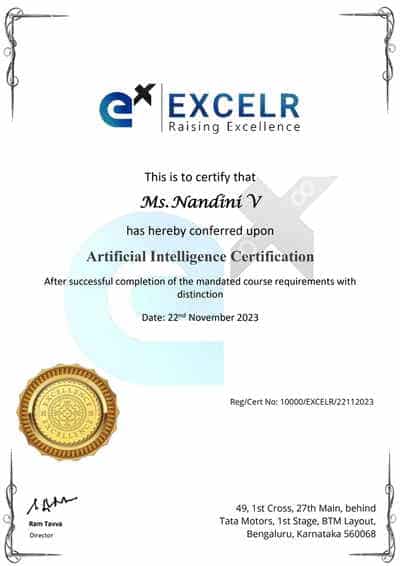
Will I Get An Artificial Intelligence Course Completion Certification From ExcelR?
Yes, after successfully completing the course you will be awarded a course completion certificate from ExcelR.
Whom Should I Contact If I Want More Information About The Training?
You can reach out to us by visiting our website and interact with our live chat support team. Our customer service representatives will assist you with all your queries. You can also send us an email at enquiry@excelr.com with your query. Our Subject Matter Experts / Sales Team will clarify your queries or call us on 1800-212-2121 (Toll-Free number – India), +1(281) 971-3065 (USA), 800 800 9706 (India), 203-514-6638 (United Kingdom), 128-520-3240 (Australia).
What Are The Different Modes Of Payment Available?
- The different payment methods accepted by us are
- Cash
- Net Banking
- Cheque
- Debit Card
- Credit Card
- PayPal
- Visa
- Mastercard
- American Express
- Discover
Global Presence
ExcelR is a training and consulting firm with its global headquarters in Houston, Texas, USA. Alongside to catering to the tailored needs of students, professionals, corporates and educational institutions across multiple locations, ExcelR opened its offices in multiple strategic locations such as Australia, Malaysia for the ASEAN market, Canada, UK, Romania taking into account the Eastern Europe and South Africa. In addition to these offices, ExcelR believes in building and nurturing future entrepreneurs through its Franchise verticals and hence has awarded in excess of 30 franchises across the globe. This ensures that our quality education and related services reach out to all corners of the world. Furthermore, this resonates with our global strategy of catering to the needs of bridging the gap between the industry and academia globally.