Generative AI & Agentic AI Course
Master next-generation AI skills with a hands-on Gen AI and Agentic AI course focused on real-world projects, AI agents, and practical LLM applications.
Learn both together or specialise in either track.

Students Enrolled
120

Reviews
4.8

Duration
6 Months / 240 Hours
Gen AI & Agentic AI course is a 140 hour live training designed especially for the engineering side of AI, where you'll build AI systems from zero. Design RAG pipelines, agentic workflows, and LLM-powered automation that integrate with real business tools. It also offers 100 hours of free foundational value added courses to ensure every learner enters the cohort with the Python, AI context, and MLOps grounding to keep up from Day 1.
Program Highlights

Top-Notch Faculty

Assignments and Case Studies

6 Capstone Projects
Skills Covered
Learn next-generation AI skills in our Gen AI and Agentic AI training, from crafting powerful prompts to building autonomous agents that can reason, retrieve knowledge, and execute complex tasks.
Generative AI

Generative AI

Prompt Engineering

ChatGPT & LLMs

RAG Pipeline Development
.png)
Fine-Tuning (LoRA, QLoRA, PEFT)

Quantisation Techniques

Machine Learning & Deep Learning

Natural Language Processing

Transformers & Attention Mechanisms

Multimodal

Diffusion Models

Reinforcement Learning

Model Evaluation & Benchmarking

Responsible AI & Guardrails
Agentic AI

AI Agents & Agentic AI

Multi-Agent Systems

Vector Databases

API Development & Deployment

Model Serving & Observability
Tools Covered
Master an industry-ready stack of tools and earn our Gen AI and Agentic AI certification to build, deploy, and scale intelligent solutions.
Generative AI

ChatGPT
.png)
GPT (GPT-3, GPT-4, GPT-5)

DALL.E 3

Stable Diffusion

Mistral

Llama

LangChain

LlamaIndex

HuggingFace

Python

Streamlit

Gradio

Pinecone

Milvus

FAISS
Agentic AI

LangGraph

AutoGen

CrewAI

FastAPI

Docker

MLFlow

LangSmith

Pydantic
Projects
Project 1: Intelligent Customer Support Chatbot for BFSI
- Domain: Banking & Financial Services
- Banks and financial institutions face high volumes of customer queries ranging from account inquiries to loan eligibility questions. Traditional call centres are costly and inefficient. This project involves developing an AI-powered chatbot using LLMs and task-specific agents to automatically resolve customer queries, provide personalised financial advice, and escalate complex issues to human agents seamlessly.
Project 2: AI-driven Product Pricing Optimisation
- Domain: Retail & E-commerce
- Retailers struggle to dynamically price products in a competitive market while balancing profit and market share. This project, offered in our agentic AI and gen AI course, leverages AI models and multi-agent systems to predict optimal product prices based on historical sales, market trends, and competitor pricing. Agents simulate market scenarios to recommend pricing strategies for maximum revenue and sales conversion.
Project 3: Smart Manufacturing Process Optimisation
- Domain: Manufacturing & Industrial IoT
- Factories face inefficiencies due to unoptimised workflows, machine downtime, and quality control issues. This project implements AI-driven predictive maintenance and workflow optimisation using LLM-based decision agents. The system analyses sensor data, identifies potential failures, and recommends process adjustments to improve production efficiency and reduce waste.
Project 4: Personalised Learning Assistant for EdTech
- Domain: Education Technology
- Students have diverse learning needs, and one-size-fits-all education platforms often fail to keep learners engaged. This project, as part of generative AI and agentic AI training, develops an AI-powered learning assistant using LLMs that creates personalised learning paths, answers student queries, and recommends exercises. Agents continuously adapt content based on student performance and learning pace.
Project 5: Intelligent Healthcare Diagnosis Support System
- Domain: Healthcare & Life Sciences
- Medical professionals often need to analyse large volumes of patient data to arrive at accurate diagnoses, which is time-consuming and prone to error. This project uses LLMs and specialised diagnostic agents to assist doctors in interpreting patient records, identifying patterns in medical data, and suggesting probable diagnoses, thus improving accuracy and reducing diagnostic time.
Project 6: Automated Legal Document Analysis and Contract Review
- Domain: Legal Tech
- Law firms and corporations spend significant time reviewing contracts and legal documents for compliance and risk management. This project, aligned with our generative AI and agentic AI certification, employs LLMs and document-understanding agents to automatically analyse contracts, identify critical clauses, flag potential risks, and summarise key information. This reduces manual effort and accelerates legal workflows.
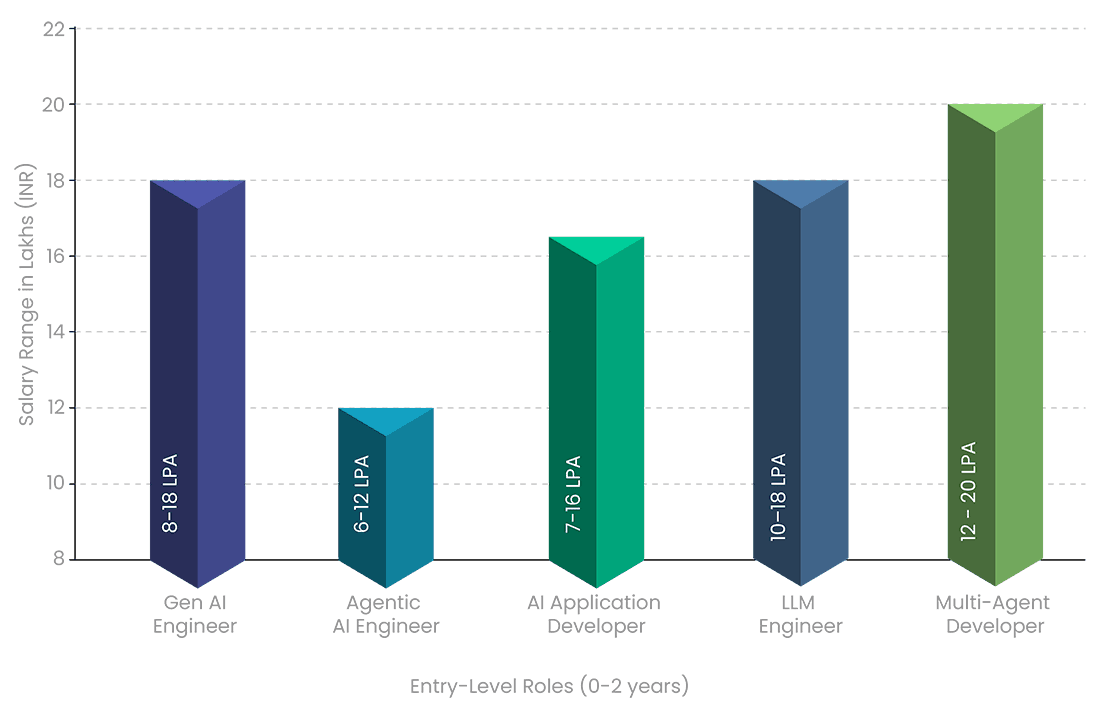
Roles and Salary Trends
Learning Path
Why ExcelR

Industry-Based Course Curriculum

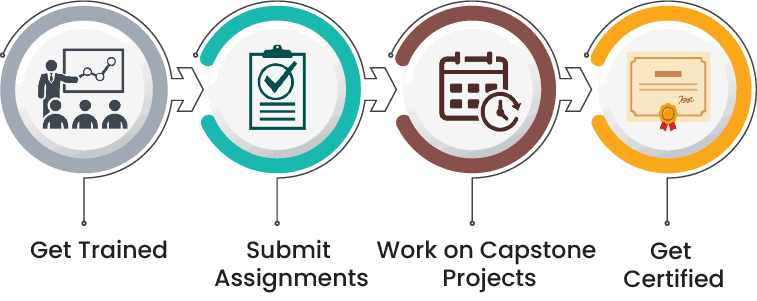
Work Hands-on with 25+ Assignments & 6 Capstone Projects

Support through WhatsApp, Calls, & Emails

eLearning Access
Course Curriculum
Generative AI & Agentic AI
Introduction & Foundations
- Foundations of Generative AI,
- History of Chat GPT models,
- Frontier models from Google, Anthropic etc,
Foundations of AI & NLP
- Types of AI: Descriptive AI vs. Generative AI,
- Example applications using sequence-to-sequence models,
Introduction to Generative AI
- Historical and latest Trends in Gen AI - GANs & LLMs models ,
Intro to Python
- variables,
- loops,
- functions,
- modules,
- libraries
Machine Learning and Deep Learning
- ML & DL fundamentals and applications
NLP Fundamentals
- NLP basics: tokenization,
- embeddings,
- TF-IDF,
- Word2Vec,
- GloVe
Advanced NLP & Generative Models
- Advanced NLP,
- Transformers,
- Attention mechanism,
- Encoder-decoder architectures
Generative AI
- Advanced Applications of Generative AI,
- Variational Autoencoders, Generative Adversarial Networks,
- Generative Pretrained Transformer models, Large Language Models
Intro to LLMs and Prompt Engineering
- Intro to prompt engineering,
- Different Types of Prompting,
- Zero Shot, Single Shot, Multi Shot, Chain of Thought,
ChatGPT in Action
- Use cases in ChatGPT,
- Practical coding tasks and automating ML project workflows,
- Chatbot Application for customer service,
- Experimenting with different GPT architectures (GPT-3 to GPT-5) ,
Bias, Fairness, Responsible AI & Guardrails
- Responsible and Ethical AI fundamentals,
- What are Guardrails, Different types of Guardrails,
- Best Industry Practices
RAG Fundamentals
- What is RAG,
- Terminology in RAG,
- RAG core concepts,
- Types of RAG, Applications of RAG
RAG Architecture
- AI hallucinations,
- Semantic Search,
- Challenges in RAG,
- RAG vs Fine-Tuning,
RAG Pipeline Evaluation
- RAG technique evaluation methods,
- LLM as judge,
- Ground truth evaluation,
- RAGAS framework and use cases
Vector Databases
- Intro to Vector Databases,
- Pinecone,
- Milvus,
- FAISS,
- Comparative Analysis between vector databases
LangChain Installation
- LangChain ecosystem,
- Installation & Setup, Core LangChain modules
LangChain Fundamentals
- LangChain agents,
- LangChain memory,
- LangChain embeddings,
- Data ingestion
LLM Workflows with LangGraph
- Intro to LangGraph
- LangGraph ecosystem
- LangGraph Ecosystem-Workflows, nodes, edges, state, execution
LLM Workflows with LangGraph, LangSmith
- Intro to LangSmith,
- LangSmith ecosystem
- LangSmith concepts- tracking, evaluation, debugging, integration
- Mini project (multi-agent workflow)
Intro to SLMs
- Intro to Small Language Models,
- Advantages of Small Language Models,
- Popular models,
- Key features,
- Performance, architectures, applications
Intro to Llama Index
- Intro to Llama Index concepts,
- Llama Index ecosystem- indexing, retrieval, memory,
- LLama Index Implementation, tools, use cases with small language models
Open Source LLMs vs Closed Source LLM’s
- Open-Source vs Closed Source,
- Benefits of Open Source,
- Examples like Mistral and Llama,
- Beyond the black box, Constraints and Challenges
Popular Open Source LLMs
- More open-source models - Qwen, Hugging Face,
- Applications, Costing, Customization,
- Security and privacy features
Evaluating LLM Models in Academics
- Choosing LLMs,
- Hugging Face leaderboards and benchmarks,
- Different categories - Reasoning, Math, Coding etc.
Evaluating LLM Models & Agents in Industry
- More Hugging Face benchmarks for AI agents,
- Tool use, Domain Specific - Legal, Finance, Medical etc.
LLM Evaluation Metrics
- Evaluation Metrics
- Perplexity, Rouge,
- BLEU, Accuracy,
- F1, efficiency metrics and use cases
Intro to Fine-Tuning LLMs
- Latest fine-tuning developments,
- OSS vs closed models,
- Unsupervised Fine-tuning, Supervised Fine-tuning,
- Instruction Fine-tuning methods
Popular Fine-Tuning LLMs
- Intro to Popular Fine-tuning techniques
- PEFT, LoRA, QLoRA, SFT,
- GRPO applications and use cases
Quantization Techniques
- What is Quantization
- Terminology in Quantization,
- Popular techniques such as AWQ, GGUF, GPTQ, EXL2
Introduction to AI Agents
- AI Agents vs Agentic AI,
- Historical Foundations of Agents,
- Timeline of Agents,
- Formal Taxonomy Framework,
- Application of Agents
Coding for Agentic AI & Pydantic
- Why Pydantic,
- Coding for Agentic AI,
- Pydantic basics & building robust applications,
- Multi step Agentic workflows
Building AI Agents
- Hands-on: Installation and Setup,
- Agent Tools, Prebuilt Agent,
- Working with Custom Agent and LangGraph
Agentic RAG
- Recent Developments in RAG,
- Agentic RAG, Agentic AI Architecture,
- Agentic AI knowledge.
- Key features - Orchestration & Intelligence,
- Benefits of Agentic RAG
LLM Agents Architecture, LLM Drift, Prompt Drift
- Prompt chaining, deep dive into LLM Agents,
- Understanding LLM drift, Prompt Drift, Cascading,
- Solutions and Future of Agentic Architectures
Knowledge Graph and Graph RAG
- Unifying Large Language Models,
- Knowledge Graph and Graph RAG concepts,
- Applications using Knowledge Graph and Graph RAG
- Advantages and Disadvantages of Knowledge RAG techniques
Intro to Multimodal Large Language Models
- Unimodal to Multimodal,
- Leading MLLMs, Architectures and Data Fusion,
- Building Applications,
- Core challenges and Limitations,
- Risks and Future of MLLMs
Applications and Architecture- Multimodal Large Language Models
- New Generation Applications in Audio and Video,
- Different MLLM Architectures,
- Comparison between frontier MLLM models,
- Ethics of MLLM models
Diffusion Models Fundamentals
- Anatomy of Diffusion models,
- Forward/reverse process,
- Backbone architecture of Diffusion models,
- Challenges and Limitations of Diffusion models
Hands-on: Stable Diffusion
- Hands-on - Hugging Face/diffusers models,
- Stability AI APIs, Text to Image applications,
- Image to Image examples,
- Cost vs Quality Trade-off,
- Future of Diffusion models
Reinforcement Learning Fundamentals
- Elements of Reinforcement Learning,
- Different RL algorithms,
- Q-learning, Exploration & exploitation,
- Problem Solving methods in RL
Reinforcement Learning Advanced
- Advanced RL models
- Policy gradient, Actor-critic,
- Proximal Policy Optimization,
- Discussion on Trending RL models
Working with Reinforcement Learning Libraries
- Working with Deep RL libraries
- OpenAI Gym, TensorFlow Agents etc.
Deployment Strategies for LLM models
- LLM operations, Deployment strategies,
- Hardware requirements, APIs,
- Docker containerization,
- Testing and Managing Deployment
Model Serving Frameworks for LLM models
- LLM operations and Deployment Concepts
- Applications using frameworks such as Fast API, Streamlit, etc.
Popular Model Serving Frameworks
- Working with different Model Serving Frameworks
- Popular Frameworks like MLFlow, Gradio, Chainlit;
- Cost and latency strategies in frameworks
Observability of LLMs
- LLM Monitoring - Average API costs, Token costs, Dashboard metrics,
- Advanced tracing of LLM models using LangSmith and LangFuse
- Discussion on Open-source observability engineering platforms
MCP
- What is MCP,
- Model Context Protocol ecosystem,
- Tool integration, MCP repository,
- MCP server in Claude,
- MCP architecture,
Deployment & Capstone Project-Industry Tools and Frameworks
- End to End Project Deployment with industry leading tools
Deployment & Capstone Project- LangGraph +LangSmith Frameworks
- End to End Capstone Project using LangGraph + LangSmith tools
Creative AI & Final Project – Popular LLM models
- Creative and Final Project on Image & Video creation
- Working with tools such as GPT-5, ImageGen 4 etc.
- Capstone Presentation
Agentic AI(LLM)-Build Agent with LangGraph System for Academics
- Academic Use Case
- End to End LLM Project Deployment (LLMs) with LangGraph Framework and its ecosystem
Agentic AI(MLLM)-Build Multi Agent with LangGraph for Academics
- Academic Use Case
- End to End Multimodal Project Deployment (MLLMs) as LangGraph and its ecosystem
Agentic AI(LLM)-Build Agent with LangGraph RAG Project for Industry
- End to End Development of POC
- Build a RAG-enabled assistant using LangGraph ecosystem and tools
Agentic AI(MLLM)-Build Multi Agent and RAG System for Industry
- Industry Use Case
- End to End Multimodal Project Deployment (MLLMs) with RAG and industry leading tools
Agentic AI-Build Agents with AutoGen
- Intro to AutoGen Framework
- Intro to Foundation Layer, Agents, Runtime concepts,
- Understanding Communication Patterns, Tools, Model Clients, Memory etc.
Agentic AI-Build Agents with AutoGen
- End to End Use Case
- Building agents with AutoGen Ecosystem and its Environment,
- Important Design Principles
Agentic AI-Build Agents with Crew AI
- Intro to Crew AI Framework
- Architecture, Roles, Autonomy and Focus,
- Safety Guardrails,
- Use case of Agents with Crew AI
Agentic AI – Build Agents with MCP
- Understanding Model-Content Prompts (MCP),
- Prompt Templates, Patterns for Multi-Role Agents,
- Agentic AI Use case with MCP server Architecture
Agentic AI Infra- Deployment Strategies, Hardware Requirements & APIs
- Deployment Architecture patterns,
- Deployment environments on Cloud and on premises,
- Containerization and Orchestration, Scaling Strategies,
- Monitoring, Memory and Storage Requirements
Agentic AI- Model Serving Ecosystem and Optimization
- What is Model Serving,
- Model Serving Architecture patterns,
- Model Serving frameworks and platforms,
- Serving optimization techniques for Agentic LLM workflows,
Contact Our Team of Experts
Why ExcelR?
FAQs
Is this course suitable for beginners with no AI background?
- Yes. The program starts with fundamentals like Python, AI basics, and prompt engineering before moving into advanced applications.
Which track should I choose: Generative AI or Agentic AI?
- If you enjoy building AI applications using LLMs and advanced AI models, Generative AI is a great starting point. If you're interested in automating workflows and developing intelligent systems that can plan and act, Agentic AI builds on those skills and is a strong fit. We recommend learning both because Generative AI generates insights and content, while Agentic AI turns it into automated action.
Can I take the Gen AI course or Agentic AI course separately?
- Yes. You can choose to learn the technologies separately as well based on your career goals.
What are the value-added courses included?
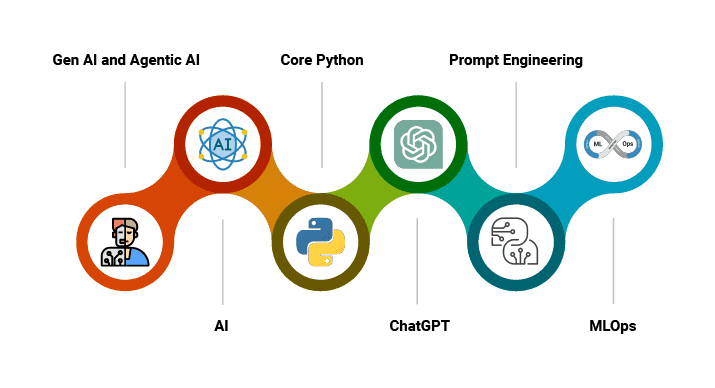
- Value-added courses are supplementary modules that help you build essential supporting skills alongside the main program. You get AI Fundamentals, Core Python, ChatGPT, Prompt Engineering, and MLOps modules to support a smooth transition from classroom learning to workplace applications.
What is ExcelR's Jumbo Pass?
- Jumbo Pass gives LMS access, session recordings, and additional learning resources for 365 days. This means even after course completion, you can access the live virtual classes from a trainer of your choice until the pass expires.
How long is the Gen AI and Agentic AI course duration?
- The duration typically spans six months, depending on the batch schedule and learning mode.
Who conducts the training sessions?
Sessions are handled by industry experts with real-world AI implementation experience.
How are classes conducted?
- Live instructor-led sessions with hands-on projects, practical assignments, and recorded access aligned with gen AI and agentic AI course.
What are the eligibility or prerequisites for this Generative AI and Agentic AI training?
- Basic computer knowledge and logical thinking are enough. Programming basics are taught during the course.
Will I work on real-world projects?
- Yes. You’ll build AI agents, automation workflows, and LLM-based applications as part of the Generative AI and Agentic AI Course learning experience.
What certification will I receive after completion?
- You will receive a course completion certificate from ExcelR and an internship certificate from AiVariant. If you choose this comprehensive program, certificates will cover both domains; if you enrol in an individual track, certifications will be issued for the respective course you complete.
Can working professionals take this course?
- Yes. Flexible schedules and recorded sessions make it suitable for professionals pursuing an agentic AI and gen AI training alongside work.
What career opportunities are available after this Agentic AI and Gen AI course?
- Rewarding roles are open today, including AI Engineer, AI Automation Specialist, LLM Developer, and Intelligent Systems Analyst.
How is this Generative AI and Agentic AI course different from what’s available online for free?
- You get structured mentorship, guided projects, expert sessions, and practical deployment exposure not available in self-learning paths.
Is this course future-proof for AI careers?
- Yes. It prepares learners with practical skills validated through Agentic AI and Gen AI certification pathways and industry-aligned training.
Global Presence
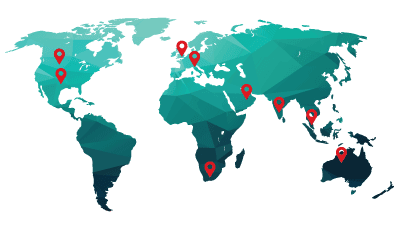
ExcelR is a training and consulting firm with its global headquarters in Houston, Texas, USA. Alongside to catering to the tailored needs of students, professionals, corporates and educational institutions across multiple locations, ExcelR opened its offices in multiple strategic locations such as Australia, Malaysia for the ASEAN market, Canada, UK, Romania taking into account the Eastern Europe and South Africa. In addition to these offices, ExcelR believes in building and nurturing future entrepreneurs through its Franchise verticals and hence has awarded in excess of 30 franchises across the globe. This ensures that our quality education and related services reach out to all corners of the world. Furthermore, this resonates with our global strategy of catering to the needs of bridging the gap between the industry and academia globally.