
Java Full Stack Developer Course Training in Bangalore
With Job Interview Guarantee (JIG)*
Join India's leading Full Stack Development Course that is based on an industry-relevant curriculum, learn from expert faculty who have hands-on experience, and get guaranteed job interviews* with our 2000+ hiring partners until you land your first job.




Course Path
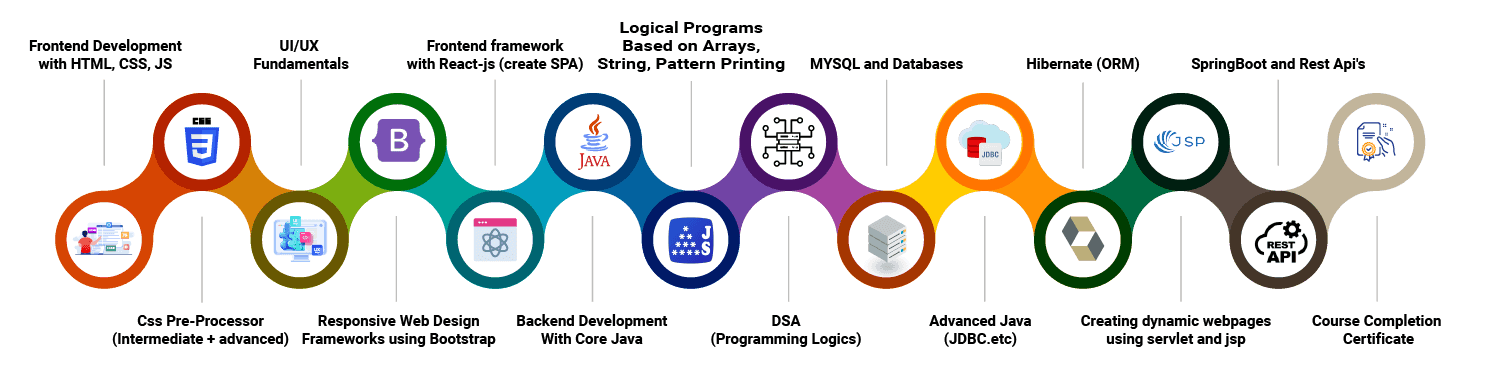
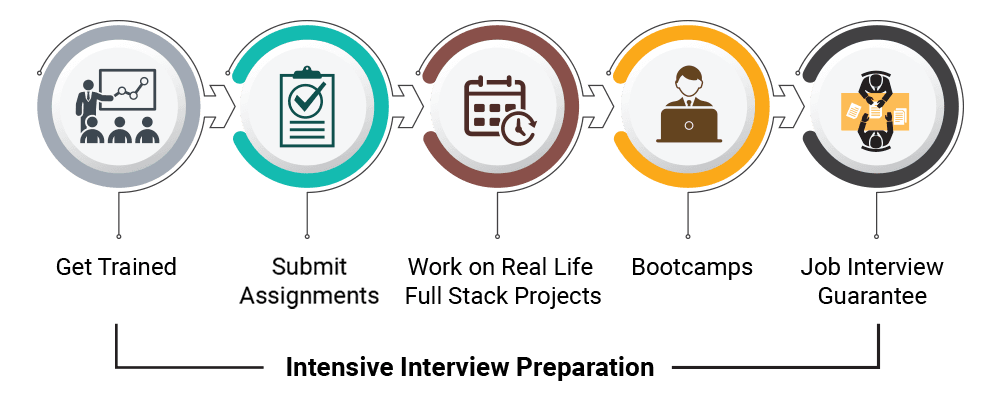
Program Highlights

Top-Notch Faculty

Assignments and Coding Challenges

Guaranteed Job Interviews

Real-life Projects and Bootcamps
Skills Covered

HTML

CSS

Bootstrap

Javascript

JQuery

ReactJS

Core Java

MySQL

Jdbc

Servlet

JSP

Spring

Spring Boot
Tools Covered

Eclipse

Postman

REST API

IntelliJ

Spring Tool Suite

Apache Tomcat

GIT

Maven
NETLIFY
MySQL workbench

VS Code
Projects
Project 1: To-Do List Application
- Beginner
- A responsive To-Do List web application to create, update, and delete daily tasks. Implemented dynamic task management using JavaScript with local storage support for data persistence. Designed a clean user interface using HTML and CSS. This project strengthened your understanding of DOM manipulation and client-side logic.
Project 2: Expense Tracker
- Beginner
- An Expense Tracker application to record and categorize daily expenses with real-time balance calculation. Implemented JavaScript for CRUD operations and local storage for saving user data. Designed an intuitive UI using HTML and CSS. Improves skills in data handling and frontend validation.
Project 3: Banking Application
- Intermediate Level
- A Banking Application supporting account creation, balance inquiry, fund transfer, and transaction history. Implemented backend logic using JDBC, Servlets, and JSP with MySQL database integration. It focus on secure data handling and session management. It helps to gain practical experience in Java EE architecture.
Project 4: Student Management Application
- Intermediate Level
- This project simulates an Student management system using Java, Spring Boot, React, and MySQL, enabling Student record creation, updates, and department management. It focus on backend CRUD operations, secure role-based access, and efficient data handling.
Project 5: E-Commerce Application
- Advanced
- It help to develop a full-stack E-Commerce platform featuring user authentication, product listing, cart management, and order processing. Built RESTful APIs using Spring Boot and integrated MySQL for database operations. Design dynamic frontend using React.It Enhances experience in full-stack development and API integration.
Project 6: Online Hospital Management System
- Advanced
- Hospital Management System to manage patients, appointments, doctors, and billing. Integrated email notifications for appointment confirmations using mailing services. Built backend APIs with Spring Boot and frontend with React. It improve skills in complex system design and real-world workflows.
Project 7: Job Portal Application
- Advanced
- Job Portal allowing employers to post jobs and candidates to apply online. Implementing user authentication, job listings, application tracking, and email notifications. Uses Spring Boot for backend services and React for frontend UI. It provides experience in scalable application development.
Real-life Interview Case Studies
Project 1: EduGorilla
- EduGorilla is an online education platform that uses ReactJS for its front-end development and Java for its back-end development. Learners will study the different features and functionalities of the platform and explore ways to improve it further using their knowledge of Java and ReactJS.
Project 2: Taskworld
- Taskworld is a project management platform that uses ReactJS for its front-end development and Java for its back-end development and can serve as a relevant case study, as it demonstrates how these technologies can be used to create a powerful and effective project management platform.
Project 3: Dropbox
- Dropbox is a popular file hosting service that uses ReactJS for its front-end development and Java for its back-end development. Senior level professionals will benefit from studying its functionalities and exploring ways to improve it further using their knowledge of Java and ReactJS.
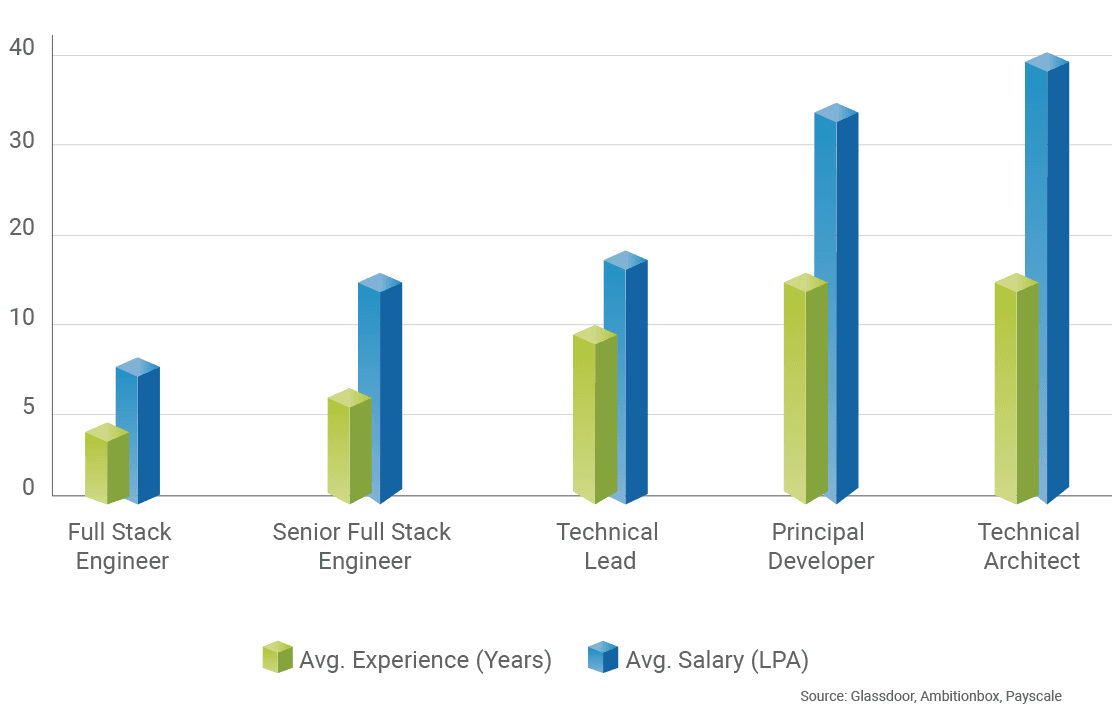
Career Progression and Salary Trends
Learning Path
Course Curriculum
Module 1 - HTML & CSS
- Introduction
- What is FullStack ? And Technologies Explaination?
- HTML Introduction
- what are web technologies
- what is html
- versions of html
- what are tags
- what is html element
- what are attributes
- differences between html & html5
- features of html5
- structure of webpage
- software installation
- Headings & CSS Introduction
- what are different headings in html
- what is css
- how to use css (internal,external,and inline)
- what is margin
- what is border
- what is padding
- box model in css
- paragraphs in html
- what is selector
- grouping/combined selector in css
- what are inline elements
- what are block level elements
- how to convert "inline to block" and viceversa
- Divisions Buttons Images what are selectors how to use font awesome
- explain div tag
- class selector
- id selector
- differences between class selector and id selector
- differences between external css and internal css
- css specificity rule
- font awesome library
- what is cdn
- how to include fontawesome in html files
- Tables
- Table with basic tags
- table attributes
- pseudo classes
- pseudo elements
- differences between pseudo classes & pseudo elements
- Anchor Element iframe tag embed tag marquee tag text formating tags differences between inline,block and inline-block legend tag
- Anchor Element
- iframe tag
- embed tag
- marquee tag
- text formating tags
- differences between inline,block and inline-block
- Forms
- Login Form
- Registration Form
- Enrollment Form
- radio buttons
- check boxes
- select
- submit button
- reset button
- CSS3 Flex
- what is css flex
- properties of flex
- applications in flex
- CSS3 Grid
- what is css grid
- differences between flex & grid
- grid properties
- applications in grid
- Media Queries
- Responsive web design
- small(sm)
- medium(md)
- large(lg)
- extralarge(xl)
- extraextralarge(xxl)
- Applications
- Capstone Project
- CapStone Project by using
- Flex
- Grid
- Deployment (Netlify)
- Semantic Elements
- header , nav , aside, main, footer , audio ,video
- CSS Positions
- relative
- absoute
- fixed
- static
- sticky
- CSS Dimensions
- 1) px 2) em 3) rem 4) % 5) vw(viewport width) and vh(viewport height)
Module 2 - JAVASCRIPT
- Introduction to JavaScript
- Introduction to JavaScript
- How to include JavaScript
- Operators in JavaScript
- Ternary Operator
- And Other Basic Concepts in JavaScript
- Variables
- what are variables
- how to declare variables
- var,let and const
- rules to declare variables
- datatypes
- primitive datatypes
- non primitive datatypes
- differences between primitive and non primitive datatypes
- var, let and const keyword differences
- variable hoisting
- global polluting issue
- temporal dead zone
- Functions
- What is Functions
- why functions
- types of functions
- function declaration
- function expression
- arrow functions
- callback functions
- constructor functions
- generator functions
- IIFE
- higher order functions
- Functions Declaration, Function Expression, Arrow Functions Examples Including DOM Manipulations Ex. Login Form
- CallBack Functions & Promises
- what are callback functions
- callback hell
- what are promises
- states in promises
- what is then() function
- async & awit keywords
- Promise.all()
- Promise.race()
- Promise.allSettled()
- JQuery Integration
- Examples on JQuery
- Constructor Functions IIFE Generator Functions HigherOrderFunctions
- prototype
- prototype chaining
- why IIFE Functions
- syntax
- why generator functions
- syntax
- why higherorderfunctions
- syntax
- JSON
- JSON Objects
- JSON Arrays
- Object Methods
- Merge JSON Objects
- Add JSON Properties
- Delete JSON Properties
- Iterate JSON Objects
- Destructuring JSON Objects
- Arrays Manipulations
- All ES6 Methods(50+ methods)
- DOM Manipulations
- Element Accessing
- Attribute Accessing
- Style Applying
- Event Manipulations
- Closures this keyword Events
- what are closures
- explain this keyword
- event bubbling
- event capturing
- call()
- apply()
- bind()
- Forms With Validations
- Username validation
- Password Validation
- Email Validation
- Mobile Number Validations
Module 3 - REACTJS
- React
- React Introduction
- React Advantages
- React Installation
- React First Application
- Application Directory Structure
- components
- what are react components
- types of components
- pure components
- higher order components
- Functional Components
- Presentational & Container Components
- Controlled & Uncotrolled Components
- Differences Between Functional and Class Components
- Applications In React Components
- State
- what is state
- what are props
- what is props drilling
- differences between state and props
- managing props drilling in react
- context api in react
- redux introduction
- Events Handling
- click event
- double click event
- handling mouse events
- lazy loading
- Styles
- inline style
- external style
- applying styles by using index.css file
- applying bootstrap/other frameworks/library
- applications
- Single Page Applications
- what are single single page applications
- react-router-dom library
- navigation between components
- passing parameters in react components
- hooks related to single page applications
- Applications Implemetation in Single Page Applications
- API Calls
- axios library
- installation of axios
- get request
- get request with headers
- pot request
- post request with headers
- put request
- put request with headers
- delete request
- delete request with headers
- send tokens in headers
- Hooks in React
- what are Hooks
- commonly used hooks
- usState() hook
- useEffect() hook
- useRef() hook
- useReducer() hook
- useNavigate() hook
- Custom Hooks
- Redux
- what is redux
- redux architecture
- components in redux
- middleewares in redux
- differences between thunk and saga
- StateManagement
- Context API
- Redux Application
- Redux Toolkit
- Applications in Redux
- NodeJS
- MongoDB
- ExpressJS
- NodeJS
- API Calls
- GET
- POST
- PUT
- DELETE
- CRUD Operations
Module 4 - COREJAVA
- Language Fundamentals
- Overview of Java
- History and Features of Java
- JDK, JRE, and JVM
- Setting up the Java Environment
- Installing JDK and IDE (e.g., IntelliJ IDEA, Eclipse, STS)
- Writing, Compiling, and Running a Java Program
- Structure of a Java Program
- Java Keywords
- Identifiers and Naming Conventions
- Data Types
- Variables and Constants
- Type Casting
- Input and Output in Java (Using Scanner and System.out)
- Operators and Expressions
- Arithmetic Operators
- Relational and Logical Operators
- Assignment Operators
- Increment and Decrement Operators
- Conditional (Ternary) Operator
- Operator Precedence
- Statements
- Simple Statements
- Conditinal Statements
- Looping Statements
- Breaking Statements
- Continue Statements
- Pattrens
- Arrays
- Arrays Manipulations
- Single Dimensional Arrays
- Multi Dimensional Arrays
- Jagging Arrays
- Strings
- String Manipulations
- Logical Questions
- String
- StringBuffer
- StringBuilder
- StringTokenizer
- OOPS
- OOPS Concepts
- Class
- Object
- Abstraction
- Encapsulation
- Inheritance
- Polymorphism
- and all other concepts related to OOPS
- Practical Examples
- Modifiers
- public
- private
- protected
- default
- static
- synchronized
- volatile
- native
- Practical Examples
- Exceptional Handling
- try
- catch
- finally
- throw
- throws
- Multi Threading
- what is multi threading
- how to create thread
- how to start thred
- synchronized
- Dead Lock
- all other concepts in Multi Threading
- Collection Framework
- what are Collections
- differences between Arrays and Collections
- Key interfaces in Collection
- List Interface and implemented classes
- Cursors
- Set Interface and implemented classes
- Map interface and implemented classes
- Queue Intefface and implemented classes
- Java8 Features
- Lamda Expressions
- Stream API
- Functional Interaface and Method Reference
Module 5 - DATABASE
- SQL
- Introduction to SQL
- What is SQL?
- Importance and applications of SQL
- Database vs. DBMS
- Overview of RDBMS
- Popular RDBMS software (MySQL, PostgreSQL, Oracle, SQL Server, etc.)
- SQL Basics
- SQL syntax and structure
- Data Types in SQL (e.g., INT, VARCHAR, DATE, etc.)
- Understanding Tables, Rows, and Columns
- Creating and Managing Databases
- CREATE DATABASE
- USE DATABASE
- Data Definition Language (DDL)
- Creating Tables: CREATE TABLE
- Altering Tables: ALTER TABLE
- Dropping Tables: DROP TABLE
- Constraints
- Primary Key
- Foreign Key
- Unique
- Check
- Default
- Not Null
- Data Manipulation Language (DML)
- Inserting Data: INSERT INTO
- Updating Data: UPDATE
- Deleting Data: DELETE
- Retrieving Data: SELECT
- Basic SELECT queries
- Filtering with WHERE
- Using Comparison Operators (=, !=, >, <, LIKE, BETWEEN, IN)
- Sorting Results: ORDER BY
- Functions in SQL
- Aggregate Functions
- SUM()
- AVG()
- COUNT()
- MAX()
- MIN()
- Scalar Functions
- String Functions (LEN, CONCAT, SUBSTRING, etc.)
- Date Functions (NOW, CURDATE, DATE_FORMAT, etc.)
- Mathematical Functions (ROUND, ABS, POWER, etc.)
- Joins and Relationships
- Understanding Relationships in Databases
- Types of Joins
- Inner Join
- Left Join
- Right Join
- Full Outer Join
- Cross Join
- Self Join
- Triggers, PLSQL, Stored Procedures Introduction
Module 6 - JDBC & SERVLETS INTRODUCTION
- JDBC Servlets JSP'S
- Overview of JDBC
- Client Server Architecture
- Overview of Servlets
- Overview of JSP
- JDBC Application
- Servlet Applcation
- JSP Application
- Applications on above topics
- CRUD Operations
- CRUD Operations in Servlets with DataBase
- JSP
- Introduction to JSP, Few Applications in JSP
Module 7 - SPRING BOOT
- Spring Introduction
- what is spring
- modules in spring
- differences between spring and spring boot
- spring core introduction
- basic application in spring core
- basic example in spring mvc module
- Spring MVC Application
- spring mvc expalnation
- Model
- View
- Controller
- Complete Appln in Spring MVC
- Spring Boot Basics
- Spring Boot Fundamentals
- Annotations in Spring Boot:
- @SpringBootApplication
- @Component, @Controller, @Service, @Repository
- @RestController and @RequestMapping
- Application Properties and YAML Configuration
- Profiles in Spring Boot
- Creating RESTful APIs with Spring Boot
- Spring Data JPA
- Spring Boot with Databases
- Introduction to Spring Data JPA
- CRUD Operations using Spring Boot and JPA
- Repository Layer:
- CrudRepository
- JpaRepository
- CRUD Operations (END TO END Application)
- Spring Security
- Spring Security Introduction
- Basic Security
- Configure username & password in application.properties file
- Role Based Authentication
- role based authentication in spring boot 4.x
- JWT Authentication
- jwt authentication in spring boot 4.x
- OAuth2 Authentication
- oauth2 authentication in spring boot 4.x
- FullStack Application
- Frontend: ReactJS
- Backend: Spring Boot
- DataBase: MySQL
Contact Our Team of Experts
Why ExcelR?
FAQs
What Is Instructor-Led Online Training?
- Instructor-led online training is an interactive mode of training where participants and trainer will log in at the same time and live sessions will be done virtually. These sessions will provide scope for active interaction between you and the trainer.
How Many Batches Can I Attend, If Enrolled For Training?
- ExcelR offers a blended model of learning. In this model, you can attend classroom, instructor-led live online and e-learning (recorded sessions) with a single enrolment. A combination of these 3 will produce a synergistic impact on the learning. You can attend multiple Instructor-led live online sessions for one year from different trainers at no additional cost with the all new and exclusive JUMBO PASS.
Is This A Live Training Or Recorded Sessions?
- It is a live instructor-led interactive session which is done at a specific time where participants and trainer will log in at the same time. The same session will be also recorded and access will be provided to revise, recap or watch any missed session.
What If I Miss A Live Session?
- Not a problem even if you miss a live Full Stack Development session for some reason. Every session will be recorded and access will be given to all the videos on ExcelR’s state-of-the-art Learning Management System (LMS). You can watch the recorded Full Stack Development sessions at your own pace and convenience.
Will I Get A Full Stack Development Course Completion Certification From ExcelR?
- Yes, after successfully completing the course you will be awarded a course completion certificate from ExcelR.
Whom Should I Contact If I Want More Information About The Training?
- You can reach out to us by visiting our website and interact with our live chat support team. Our customer service representatives will assist you with all your queries. You can also send us an email at enquiry@excelr.com with your query. Our Subject Matter Experts / Sales Team will clarify your queries or call us on 1800-212-2121 (Toll-Free number – India), +1(281) 971-3065(USA), 800 800 9706 (India), 203-514-6638 (United Kingdom), 128-520-3240 (Australia).
What Are The Different Modes Of Payment Available?
- The different payment methods accepted by us are
- Cash
- Net Banking
- Cheque
- Debit Card
- Credit Card
- PayPal
- Visa
- Mastercard
- American Express
- Discover
Global Presence
ExcelR is a training and consulting firm with its global headquarters in Houston, Texas, USA. Alongside to catering to the tailored needs of students, professionals, corporates and educational institutions across multiple locations, ExcelR opened its offices in multiple strategic locations such as Australia, Malaysia for the ASEAN market, Canada, UK, Romania taking into account the Eastern Europe and South Africa. In addition to these offices, ExcelR believes in building and nurturing future entrepreneurs through its Franchise verticals and hence has awarded in excess of 30 franchises across the globe. This ensures that our quality education and related services reach out to all corners of the world. Furthermore, this resonates with our global strategy of catering to the needs of bridging the gap between the industry and academia globally.